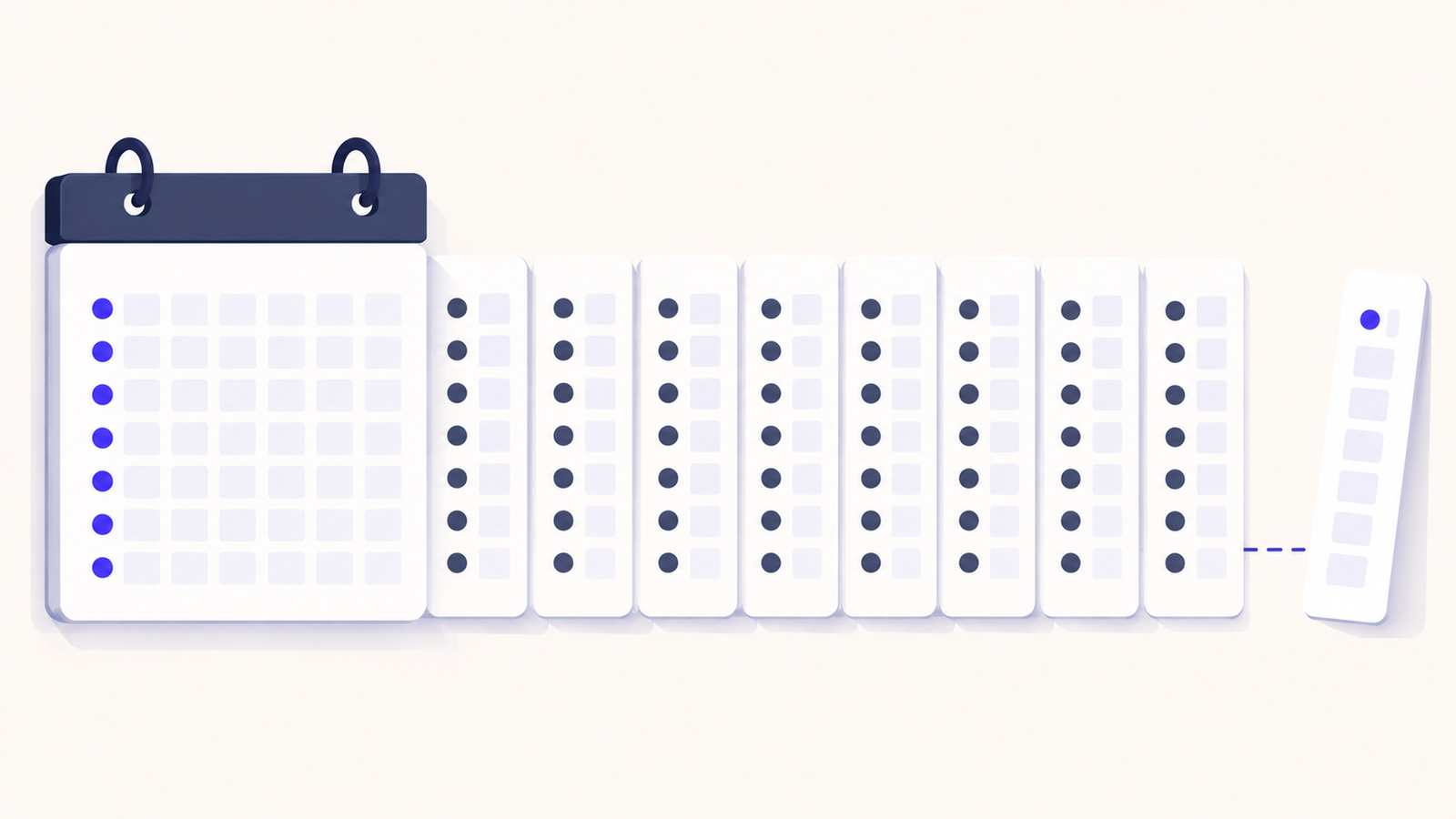
How many weeks are in a year? You probably learned it's 52, and that's the number most people keep in their head.
It's close. A year is really 52 weeks and a bit, and that leftover bit is why your birthday lands on a different day of the week each year.
Then there's the odd part. If you use week numbers at work, you may have hit a year with 53 of them and wondered where the extra one came from. 2026 is exactly that kind of year.
The short answer
Every year has 52 weeks plus 1 extra day. A leap year has 52 weeks plus 2 extra days, since it runs 1 day longer.
So the precise count is 52 weeks and roughly 1.14 days, a little more than a round number.
ISO 8601, the international standard behind week numbers, divides the year into whole weeks instead. Most years come out to 52. A few land on 53, and 2026 is one of them.
How many weeks are in 2025 and 2026?
2025 has 52 weeks. It started on a Wednesday and isn't a leap year, so it follows the standard pattern of 52 weeks plus 1 day.
2026 has 53 ISO weeks. It started on a Thursday, which is what triggers a 53-week year (I explain the rule below). On a plain calendar 2026 is still 52 weeks and 1 day, but its week numbers run all the way to 53.
So if you're filling in a planner or setting up week-numbered schedules, 2025 stops at week 52 and 2026 goes to week 53.
Why a year isn't exactly 52 weeks
Here's the math. 52 weeks times 7 days is 364 days. But a common year runs 365 days, and a leap year runs 366.
That leaves 1 spare day in a normal year and 2 spare days in a leap year. Seven doesn't divide evenly into 365 or 366, so you always end up with whole weeks plus a small remainder.
This is also why the calendar drifts. If your birthday is on a Tuesday this year, it shifts to a Wednesday next year, then jumps two days after a leap year. The extra day nudges everything forward.

How many weeks are in a leap year?
A leap year has 366 days, which is 52 weeks and 2 days.
Leap years arrive every 4 years, following a rule that skips some century years. 2024, 2028, and 2032 are leap years. 2026 is not.
The extra day is February 29. It adds 1 more day to the remainder, so a leap year carries 2 spare days instead of 1. That still isn't enough for a 53rd week on an ordinary calendar, though a leap year can produce a 53-week ISO year, which is the separate case below.
When does a year have 53 weeks?
This only happens in the ISO 8601 system, used across most of Europe and throughout business and software.
ISO weeks always start on Monday. Week 1 is the week holding the year's first Thursday, which is the same as the week that contains January 4.
A year gets 53 weeks when one of two conditions is true:
- January 1 falls on a Thursday, or
- It's a leap year and January 1 falls on a Wednesday.
2026 starts on a Thursday, so it has 53 weeks. Week 53 of 2026 runs Monday December 28 2026 to Sunday January 3 2027. Those first three days of January 2027 sit inside 2026's final week, not in 2027.
There's a fuller breakdown of why some years have 53 weeks if you want the longer version.
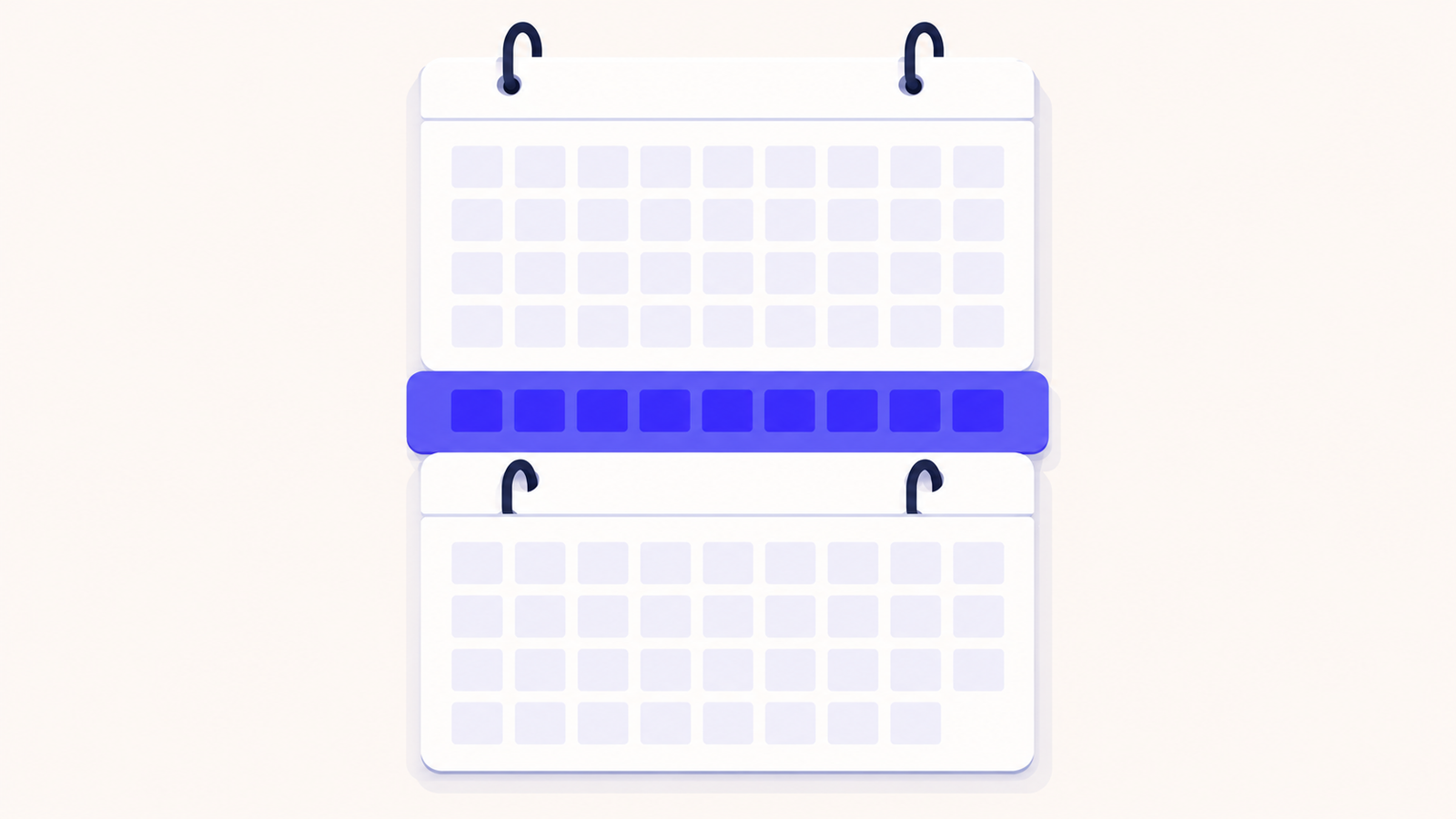
If you want to test any year yourself, this Excel formula returns the ISO week number of a given date:
CODE0
For December 31 2026 it returns 53. Run it on December 31 2025 and you get 1, because that date already sits in week 1 of 2026.
Which years have 53 weeks?
53-week years don't fall on a neat interval. They show up every 5 or 6 years, decided by where January 1 lands and whether the year is a leap year.
Here are the recent and upcoming ones:
| Year | ISO weeks | Starts on | Leap year? |
|---|---|---|---|
| 2015 | 53 | Thursday | No |
| 2020 | 53 | Wednesday | Yes |
| 2025 | 52 | Wednesday | No |
| 2026 | 53 | Thursday | No |
| 2032 | 53 | Thursday | Yes |
| 2037 | 53 | Thursday | No |
Every year not listed as 53 has 52 ISO weeks. So 2025 has 52, 2026 has 53, then it drops back to 52 until 2032. You can open the full 2026 week calendar to see all 53 weeks set out.
52 vs 53 weeks: the two systems side by side
Keeping the two systems apart helps, because they answer slightly different questions.
| Feature | US-style / everyday | ISO 8601 |
|---|---|---|
| Weeks in a year | 52 weeks + 1 or 2 days | 52 or 53 whole weeks |
| Week starts on | Sunday (common in the US) | Monday |
| Is January 1 in week 1? | Yes, week 1 starts January 1 | Not always; it can fall in the prior year's last week |
| Mainly used for | Everyday calendars and planning | Business, payroll, software, most of Europe |
| 2026 count | 52 weeks + 1 day | 53 weeks |
Most people mean the everyday version when they ask how many weeks are in a year. The 53-week answer turns up once you start working with formal week numbers, the kind defined by ISO 8601.
What 53 weeks means for pay and planning
A 53-week year quietly affects a few real things.
If you're paid weekly, most years bring 52 paychecks. A 53-week year can hand you 53, depending on your pay dates. Paid every 2 weeks? You usually get 26, but a long year occasionally brings 27.
Companies that run on week numbers, like retailers using a fiscal calendar, have to decide how to absorb the extra week. Many run a 53-week financial year now and then to stay aligned with the calendar.
For everyone else, that leftover day is the reason fixed dates drift. Your birthday and any other annual date creep forward by 1 weekday each year, and by 2 after a leap year's extra day.
FAQ
How many weeks are in a year exactly?
A common year has 52 weeks and 1 day (365 days), and a leap year has 52 weeks and 2 days (366 days). The exact figure is about 52.14 weeks, since 52 whole weeks only cover 364 days.
How many weeks are in a leap year?
A leap year has 366 days, which works out to 52 weeks plus 2 days. The extra day is February 29. In everyday terms a leap year still has 52 weeks, just with one more spare day than a normal year.
Why does 2026 have 53 weeks?
In ISO 8601 a year has 53 weeks if it starts on a Thursday, or if it's a leap year starting on a Wednesday. January 1 2026 is a Thursday, so 2026 has 53 ISO weeks. Week 53 runs December 28 2026 to January 3 2027.
Is January 1 always in week 1?
In ISO 8601, no. If January 1 lands on a Friday, Saturday, or Sunday, it belongs to the last week of the previous year. It falls in week 1 every time only in the US-style system, where week 1 always starts on January 1.
When is the next 53-week year after 2026?
2032, followed by 2037. The years 2027 through 2031 all have 52 ISO weeks. The gap between 53-week years is usually 5 or 6 years.
Quick reference
- Every year: 52 weeks + 1 day, or 52 weeks + 2 days in a leap year
- ISO 8601 years: 52 or 53 whole weeks
- Recent and upcoming 53-week years: 2015, 2020, 2026, 2032, 2037
- 2025 has 52 weeks; 2026 has 53
- See today's week number on the WeekIsIt homepage, or convert any date with the week calculator
Sources and further reading
- ISO 8601 date and time format: the official ISO standard page
- ISO week date on Wikipedia, covering how 53-week years are determined
- Leap year on Wikipedia, with the full leap year rules